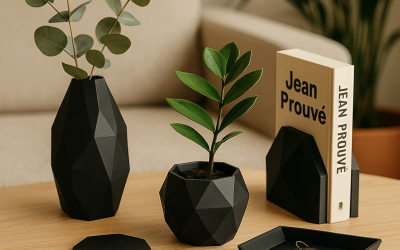

When most people think of 3D printing, they imagine futuristic machines, prototypes, or even sci-fi experiments. But today, 3D printing is already reshaping something much closer to home: the way we design and decorate our living spaces.
At EcoCrafted, we’ve embraced this revolution by combining AI-generated design with eco-friendly 3D printing. The result? Everyday objects that are as unique as they are sustainable.
🎨 Unlimited Creativity
Traditional manufacturing relies on molds, factories, and mass production. That means most products are designed for efficiency, not creativity. With 3D printing, that barrier disappears.
-
Complex shapes? Possible.
-
Bold geometric designs? Easy.
-
One-of-a-kind pieces? Standard.
Every product we make, from our GeoVases to GeoPlanters, is designed to look and feel like a piece of modern art — without the mass-production limitations.
🌱 Sustainability at the Core
The biggest win? Less waste.
-
Products are printed only when ordered → no warehouses of unsold items.
-
We use recycled plastic filament, giving new life to materials that would otherwise be wasted.
-
Local production means lower shipping footprints.
This is the opposite of fast furniture or disposable decor — it’s design with a conscience.
🏡 Everyday Objects, Reimagined
3D printing allows us to rethink everyday objects:
-
A tray isn’t just storage, it’s a sculptural centerpiece.
-
A planter isn’t just a pot, it’s a statement of style.
-
Even coasters can become conversation starters.
By merging form and function, we’re proving that design doesn’t have to choose between practical and beautiful.
🚀 What’s Next?
We believe 3D printing is just the beginning. In the near future, homes could be filled with custom-made pieces, each designed specifically for your space, your taste, and your values.
At EcoCrafted, our mission is to show that this future is possible now — by blending AI design, 3D printing, and sustainability into every product we create.
So the next time you set down your keys, pour a drink, or place fresh flowers on the table, imagine doing it with objects that aren’t just designed for living — but for living better, and greener.